
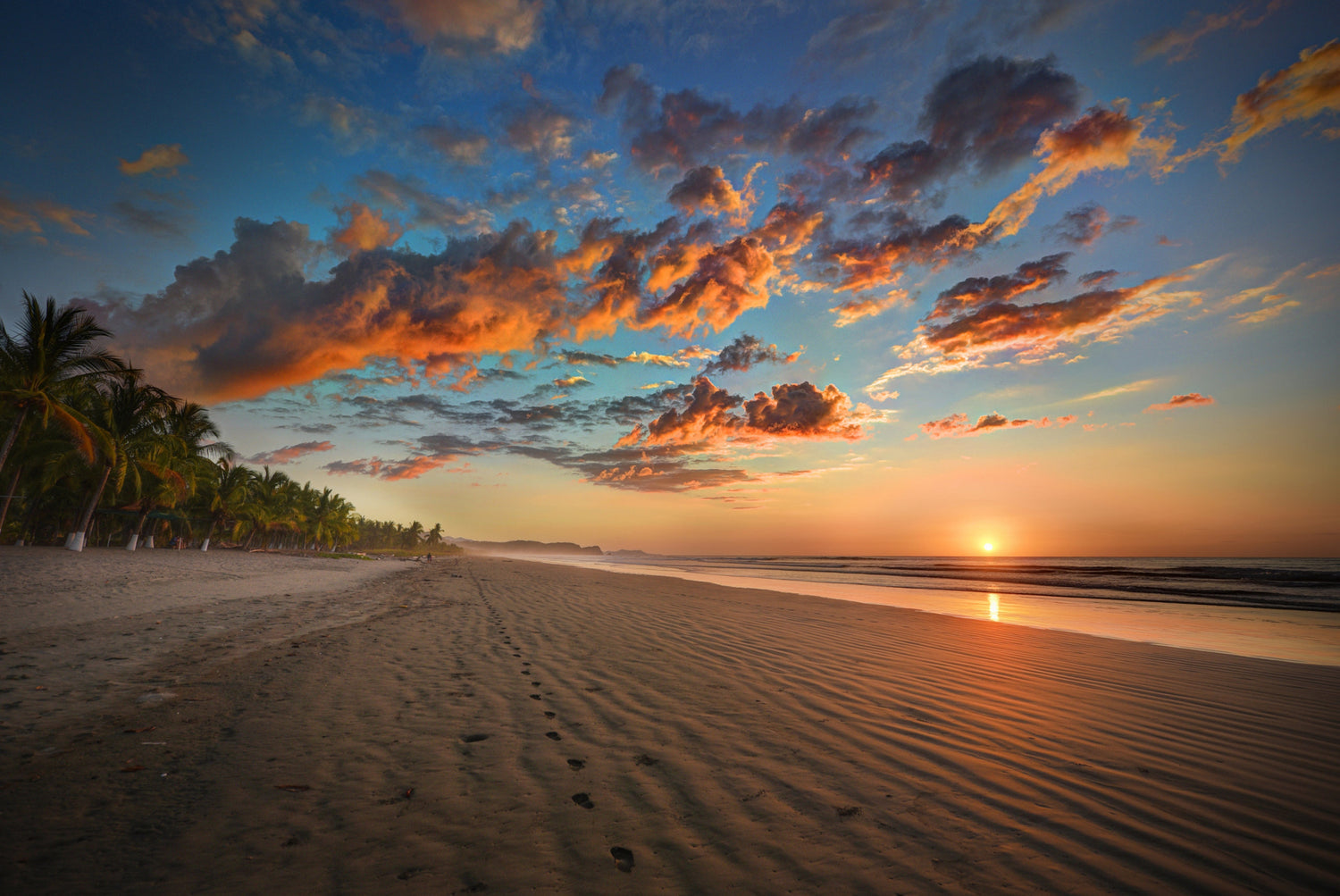
It’s no coincidence that Costa Rica is known for its beaches. With nearly 1,300 kilometers (800 miles) of coastline along both the Pacific Ocean and the Caribbean Sea, there is an extraordinary range of shoreline to explore. Some beaches are postcard-perfect, with pale sand and clear water. Others are dark, wild, and untamed, where jungle presses close to the sea and you can walk for miles without seeing another soul, aside from monkeys in the trees or scarlet macaws gliding overhead.
Whether you want to slow down, reconnect with nature, chase adventure through surfing, snorkeling, or sailing, or simply watch the sun sink into the ocean with a drink in hand, these are the best beaches in Costa Rica.
1. Best protected cove: Manuel Antonio
The small seaside town of Manuel Antonio is best known for its national park. While the village itself can feel busy, especially in high season, timing makes all the difference. Visit during low season or on a Tuesday, when the park is closed, and the town takes on a much quieter, more relaxed feel, with waves rolling onto Playa Espadilla and La Playita, both open even when the park is closed.
Do not miss Manuel Antonio National Park, even if you have to navigate the crowds. Inside the gates, you will find protected coves with turquoise water and soft white sand, backed by dense jungle and palms filled with white-faced monkeys. It really is a little pocket of paradise.


2. Best for consistent surf: Santa Teresa
On the western edge of the Nicoya Peninsula, Santa Teresa is a small beach town that runs parallel to the coast along miles of dusty road. Over the last several years, it has grown quickly, with more refined hotels and restaurants arriving alongside the steady stream of surfers who come for powdery sand and reliable swells.
A broad strip of forest frames Santa Teresa’s beach, and one of the town’s best features is its lack of high-rise buildings. The coastline remains wide and open, backed by jungle-covered hills. With warm water year-round and consistent waves, it is easy to see why Santa Teresa draws people back again and again.
Santa Teresa's growth has brought refined luxury options without losing its bohemian soul. Nantipa, a beachfront boutique retreat right in the heart of town, offers stylish bungalows with ocean views, a shoreside restaurant, and wellness touches like yoga. It's perfect for unwinding after a day of surfing or beach walks. It's a seamless fit for those seeking barefoot luxury amid the jungle-backed shores and consistent swells.


3. Best for long, romantic walks: Malpaís
A tranquil community at the southern tip of the Nicoya Peninsula, Malpaís draws surfers from around the world, but it is just as memorable for long, walkable beaches and sunsets that flood the sky with orange, red, and pink. It is fittingly dramatic for a place whose name means “badlands” in Spanish.
Spread out along roughly five kilometers of road, Malpaís sits between Cabo Blanco Natural Reserve to the south, Santa Teresa to the north, and tropical dry forest that reaches the shore. Rocky outcroppings alternate with pockets of sand, including stretches made up almost entirely of tiny shells.
Calmer and less developed than Santa Teresa, Malpaís feels like a true exhale. The ocean is the main attraction, with consistent waves and a long beach break. Beyond surfing, visitors can fish, dive, kite surf, paddleboard, and snorkel. At night, the scene stays low-key, with a handful of restaurants and bars close to the water.


4. Best edge-of-the-world vibe: Montezuma
Montezuma is a picturesque beach village with a bohemian, end-of-the-road atmosphere on the Nicoya Peninsula. Remote and a little rugged to reach, it attracts travelers who are happy to trade convenience for wild coastline, warm water, and jungle that dips down to meet the sea.
Montezuma’s main strip runs parallel to the ocean, lined with charming wooden houses, small hotels, and a selection of restaurants that blend local flavor with international inspiration. It is the kind of place where days naturally slow down.


5. Most unique geographical feature: Uvita
South of Dominical, Uvita is a quiet beach town with a gentle pace of life and a thriving expat community. The town is small and set into the jungle hillside, with a network of dirt roads, farms, guesthouses, and small shops.
The area’s main attraction is Marino Ballena National Park, famous for migrating humpback whales, wild beaches, and the whale’s tail-shaped sandbar that stretches out into the ocean, best seen from above on clear days.


6. Most jaw-dropping sunsets: Dominical
Best known for its waves, the quirky little beach town of Dominical on Costa Rica’s Central Pacific has long been a favorite for travelers looking for an off-the-beaten-path feel. While the Costanera Sur highway has made the region more accessible and brought new development, Dominical has held onto its laid-back character, with unpaved roads and a noticeably non-resort vibe.
The beach in Dominical is one of the strongest surfing beaches in the country, offering consistent waves for both beginners and experienced surfers. The dark, rocky stretch of sand runs for about 4 kilometers (2.5 miles). The farther you walk, the quieter it becomes. While this is not the most photogenic beach in Costa Rica, sunsets here are spectacular, and evening often brings people to the shoreline to watch the sky change.


7. Best wild black sand beach: Carate
In Costa Rica’s South Pacific, on the Osa Peninsula, Carate is a small community beside Corcovado National Park, often described as the crown jewel of the national park system. This quiet area near the La Leona Ranger Station is rich in wildlife, long beach walks, and access to some of the most immersive hiking in the country.
The town itself is little more than a single dirt road with a few secluded hotels, restaurants, and a small shop for basic supplies. Carate’s proximity to Corcovado makes it a strong base for exploring the park. During turtle nesting season, generally June through November, several species of sea turtles return to these shores to lay eggs.


8. Best beach nightlife: Tamarindo
Once a quiet fishing village, Tamarindo has grown into one of Costa Rica’s most popular surf and nightlife hubs. Days revolve around the beach. Nights bring a lively scene of restaurants, bars, and music, plus some of the most diverse dining options in the country.
Tamarindo’s central location makes it a convenient base for exploring the northern Pacific coast, with beaches like Conchal and Flamingo nearby, and Langosta just to the south. Surfing is the headline attraction, but kayaking, sport fishing, ATVs, zip lining, and horseback riding are all easy to arrange.


9. Best Caribbean flavor: Punta Uva
South of Puerto Viejo de Talamanca, Punta Uva is known for calm, reef-protected water and soft, pale sand. The village is small, with a few dirt roads and a handful of restaurants and small hotels, all wrapped in that easy Caribbean pace.
The area is best explored by bicycle. The terrain is flat, parking is limited, and riding between beaches is part of the charm. Playa Punta Uva and Playa Punta Uva Arrecife are connected by a short jungle trail, both offering palm-fringed shoreline and clear water. Beyond beach time, hiking, snorkeling, kayaking, diving, and paddleboarding are popular here.


10. Best secluded beach: Manzanillo
Remote and lush, the Gandoca-Manzanillo Refuge sits at the far southeastern edge of Costa Rica, beyond Cahuita and Puerto Viejo. South of Manzanillo, the road ends and trails begin, leading toward Punta Mona and along quiet coves where you may not see another person all day.
The refuge protects a wide mix of habitats, including wetlands, mangroves, rainforest, and coral reef. The beaches here are palm-fringed and wild, with rocky points creating small protected areas for swimming. Offshore, reef conditions can make for rewarding snorkeling and diving when the sea is calm and visibility is good.
Wildlife is part of the experience both on land and in the water. Several species of sea turtles nest in the region seasonally, and the refuge also supports monkeys, sloths, and a wide variety of birds, reptiles, and amphibians.


11. Calmest swimming beach: Playa Chiquita
Just south of Puerto Viejo, Playa Chiquita is a quiet stretch of Caribbean coastline known for jungle-fringed bays and clear water. There is no real town center here. Instead, a scattering of small hotels and restaurants sits along the road, with rainforest pressing close on both sides.
A short trail runs parallel to the shore, connecting small protected coves that tend to stay calmer than more exposed beaches nearby. Swimming can be excellent, but keep an eye out for rocks and reef as you move farther out.


12. Best for wide, white sands: Playa Conchal
Playa Conchal is known for sand made from tiny crushed shells, giving the shoreline a pale, shimmering texture. The water often shifts through turquoise, aqua, and sea-foam tones, and on calmer days, the bay can be a beautiful place to swim and snorkel.
This is one of the busier beaches in the region, especially near the main access points. Still, the scenery is striking, and if you walk farther along the shoreline, it often feels more open and spacious.


13. Best for sport fishing: Playa Flamingo
Playa Flamingo is the kind of beach people picture when they imagine Costa Rica: pale sand, blue water, and the Catalina Islands offshore. The town continues to grow, with new homes and developments appearing in the surrounding hills, but the beach remains the star.
Flamingo is also a major jumping-off point for boating and fishing on the northern Pacific coast. The local marina supports a wide range of excursions, from sailing and snorkeling to world-class sport fishing.


14. Best for beachcombers: Playa Langosta
Just south of Tamarindo, Playa Langosta is quieter and more low-key, with a wide beach and strong surf. The southern end of the beach is popular with experienced surfers, and ocean conditions can be powerful, with currents and rips that deserve respect.
For long walks, tide pools, and beachcombing, Langosta is a great choice. There are fewer amenities here, which is part of the appeal. Many visitors spend their evenings in Tamarindo, then return to Langosta for calmer mornings and slower days.


15. Best local vibe: Sámara
Sámara is one of the Nicoya Peninsula’s most easygoing beach towns, with calm water, gentle waves, and a wide curve of tan sand lined with palms. It draws a happy mix of locals on vacation, foreign families, couples, and backpackers, creating an atmosphere that feels warm and lived-in.
While tourism is well established, Sámara remains free of massive all-inclusive resorts and high-rise development. The beach is spacious, the water is generally friendly for swimming, and the town still feels refreshingly unpolished.


16. Most healing vibe: Nosara
Nosara is known for its barefoot, wellness-forward energy, where yoga and surf shape the rhythm of daily life. Set back from the coast, the town feels intentionally low-profile, with nature and open space taking priority over flashy development.
The region’s beaches include Nosara, Guiones, Garza, and Pelada. Playa Nosara’s darker sand stretches toward the river mouth at Boca Nosara, where mangroves and an estuary support a remarkable variety of wildlife, including birds, monkeys, and other small mammals.


17. Best for wildlife encounters: Tortuguero
Tortuguero National Park, in the northeast of Costa Rica, is a maze of waterways, lagoons, and channels threaded through rainforest. Access is by boat or small plane, which adds to the feeling that you have stepped into a different world.
Known as one of the most important nesting sites in the Western Hemisphere for endangered green sea turtles, Tortuguero protects more than 19,000 hectares (46,960 acres) of rainforest and roughly 35 kilometers (22 miles) of coastline. The environment where freshwater meets the sea creates extraordinary biodiversity, including many species of birds, mammals, reptiles, and amphibians.
Boat, canoe, and kayak tours are among the best ways to explore. Canoeing and kayaking are especially rewarding, allowing you to slip into narrower channels where wildlife sightings can feel surprisingly close.


18. Best hidden gem: Playa Biesanz
Playa Biesanz is a small, tucked-away beach between Quepos and Manuel Antonio. Protected and often calm, it is a lovely place to spend an unhurried afternoon in clear water, especially if you want a quieter alternative to the main beaches nearby.


Costa Rica's beaches offer something for every pace, from wild, wildlife-rich shores to surf havens and calm coves. Pairing these spots with tailored adventures creates unforgettable trips. As a dedicated Costa Rica travel agency, Osaviva specializes in crafting seamless itineraries that blend beach relaxation with volcanoes, rainforests, and eco-luxury stays, whether you're eyeing Santa Teresa's waves or a multi-destination escape.
